01
Debt Payments Are Taking Up Too Much Available Cash
A large portion of incoming revenue is immediately committed to debt payments.
Cash flow support for small businesses starts with seeing when money comes in, when debt payments go out, and what is left for payroll, suppliers and operations. When debt payments and operating expenses compete for the same cash, managing your cash flow starts with understanding the timing and pressure points.
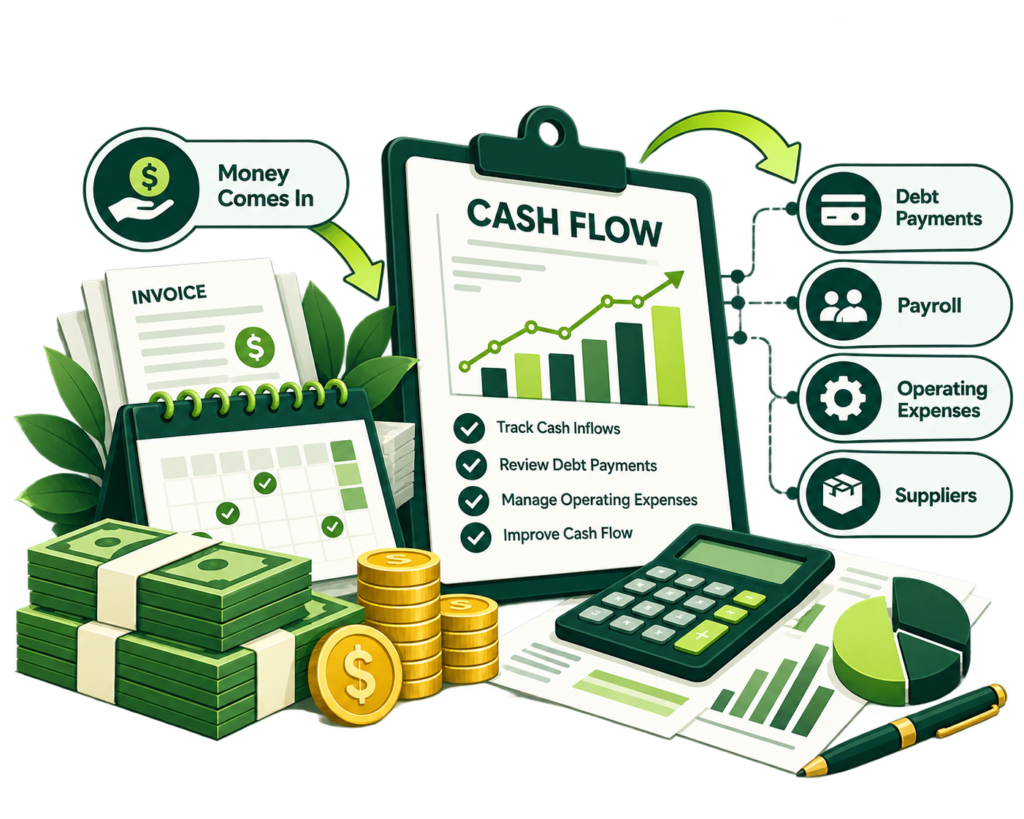
Cash flow support, sometimes called cash flow management, is about understanding when money enters and leaves your business, so you have enough working capital to cover everyday expenses, even when debt payments compete for the same cash. A business can have revenue coming in and still experience cash flow pressure if payments are due before customer receipts arrive, debt withdrawals occur frequently, or essential expenses consume much of the available cash.
A useful review looks beyond monthly revenue alone. It considers when money enters the business, when payments leave, and how those timing differences affect payroll, suppliers, inventory, rent, equipment, and other operating priorities. For businesses carrying commercial debt, cash flow support may involve reviewing payment structures, multiple obligations, operating expenses, and potential debt-relief or restructuring paths.
The goal is not to assume that one solution will work for every business. It is to create a clearer picture of the pressure before deciding what to explore.
Debt becomes a cash-flow issue when required payments consume money that the business also needs for normal operations.
For example, a business may receive customer payments later in the month while debt payments are withdrawn daily or weekly. Even if the business is generating revenue, the timing mismatch can leave less cash available when expenses are due.
Common pressure points include:
| Cash Flow Pressure | Potential Business Impact |
|---|---|
| Frequent debt payments | Less cash available between revenue receipts |
| Multiple obligations | Several payments competing for the same revenue |
| Seasonal revenue | Lower available cash during slower periods |
| Delayed customer payments | Working capital becomes harder to access |
| Rising operating costs | Less cash remains after essential expenses |
| Debt payments and payroll overlap | Greater pressure on operating reserves |
Cash-flow pressure is therefore not simply about how much revenue a business generates. Timing, expenses, payment frequency, and existing obligations all matter.
You may want to take a closer look at your cash flow if:
A large portion of incoming revenue is immediately committed to debt payments.
Sales may be strong overall, but customer payments arrive inconsistently or seasonally.
Essential operating expenses are becoming harder to cover on time.
Several MCAs, loans, credit cards, or other obligations are drawing from the same operating account.
Additional borrowing may provide temporary liquidity while increasing the overall obligation.
The business is generating sales but has little cash available between incoming and outgoing payments.
Cash flow support should begin with understanding where the pressure is coming from.
Review when customers typically pay and whether revenue changes during certain periods of the year.
Identify daily, weekly, biweekly, or monthly obligations and how they line up with incoming cash.
Consider essential expenses such as payroll, suppliers, rent, inventory, utilities, insurance, and equipment.
Look at whether several creditors or funders are competing for the same operating cash.
Determine how much cash remains available after required payments and essential expenses.
Consider what the business needs to preserve first, such as payroll, inventory, customer commitments, or ongoing operations.
There isn’t one universal cash-flow solution. Depending on the business’s obligations and circumstances, several areas may be worth reviewing.
Review whether the frequency and timing of existing payments are contributing to unnecessary short-term cash pressure. A lower periodic payment may improve immediate cash flow, but it does not automatically mean the total amount owed will decrease.
Existing obligations may sometimes be reviewed for potential restructuring or revised payment arrangements. The specific terms depend on the agreement, creditor or funder, business circumstances, and whether the relevant party agrees to changes.
When several obligations draw from the same revenue stream, reviewing them together can provide a clearer picture than looking at each payment separately. This may include MCAs, business loans, credit cards, lines of credit, equipment financing, or other commercial obligations.
Cash flow isn’t determined by debt payments alone.
Understanding essential operating expenses can help identify how much cash is actually available for debt service while keeping the business running.
In some situations, refinancing or another financing structure may be worth evaluating. However, new financing creates its own obligations. The cost, eligibility requirements, payment schedule, fees, duration, and total repayment should be considered before treating new funding as a cash-flow solution.
Cash-flow support should not automatically mean taking on more debt. It helps to separate a temporary cash shortage from debt that the business cannot realistically service over time.
Multiple obligations can make cash flow harder to understand. Imagine a business with:
For example: MCA #1, MCA #2, a business credit card, a line of credit and an equipment payment. All of these obligations may ultimately depend on the same business revenue.
That means the important question isn’t only:
“How much do I owe?”
It can also be:
“How much cash is committed before my business can pay its essential expenses?”
A coordinated review can help organize the obligations by payment amount, frequency, creditor, remaining balance, and effect on operating cash.
Cash flow problems become more serious when debt payments begin interfering with normal business activity.
A simple operating picture: Business revenue becomes available cash, which must cover payroll, suppliers, inventory, rent and operations as well as debt payments. What is left is your remaining working capital. When debt payments consume too much of the available cash, the business may have less flexibility to respond to ordinary operating needs.
For example, a business may need cash for:
The purpose of a cash-flow review is to understand these competing demands before deciding what should happen next.
A cash-flow conversation can begin with estimates. You do not need to know every number perfectly before starting the assessment.
How revenue comes in and whether it changes by week, month, season, or project.
How often existing debt obligations require payments.
The essential costs required to keep the business functioning.
The types of debt or commercial commitments currently affecting cash flow.
Whether payments are making it harder to cover normal business expenses.
What the owner needs to preserve or stabilize first. Estimates and “Not sure” responses can be used where exact figures are not known, and the initial form does not request bank credentials, account numbers, Social Security numbers or document uploads.
These concepts overlap, but they serve different purposes.
| Cash Flow Support | Business Debt Relief |
|---|---|
| Focuses on available operating cash | Focuses on existing business obligations |
| Examines revenue and payment timing | Examines debt and creditor relationships |
| Looks at operating expenses | Looks at potential relief strategies |
| Identifies cash-flow pressure points | May explore negotiation, restructuring, or settlement |
| Helps clarify the business’s current position | Helps evaluate potential debt-related next steps |
Cash flow support is therefore not automatically debt settlement. It is a broader review of how financial obligations interact with the business’s ability to operate.
A cash-flow assessment does not guarantee:
The outcome depends on the business’s circumstances, existing agreements, financial position, and the response of the relevant creditor or funder. A proposed payment change is not the same as an agreement that has actually been accepted by a creditor or funder. Always review the full proposed cost and terms rather than focusing only on the periodic payment.
Complete the short assessment with basic information about your business, obligations, and current payment pressure.
Our team reviews the information you provide to understand the general situation before following up.
Where appropriate, we identify areas that may warrant further review by a resolution team, including debt restructuring, payment discussions, or other business debt strategies.
If your situation appears appropriate for further debt-resolution assistance, we may connect you with an independent debt resolution team for the next stage.
MCA Resolution Advisory is not a law firm or debt settlement company. We assess your case and make sure it reaches the right resolution team to assist you.
Straight answers to the questions business owners ask us most. Still unsure? Talk to our team.
Cash flow support focuses on understanding how revenue, operating expenses, and debt payments interact so a business can better understand its financial pressure and potential next steps.
Not necessarily. Cash flow support is primarily a review of the relationship between business cash and financial obligations. Depending on the situation, debt-related options may be explored separately.
A payment reduction is not guaranteed. Where appropriate, a business may explore restructuring or other arrangements, but any change depends on the relevant creditor or funder’s agreement.
Multiple obligations can be reviewed together to better understand the combined payment burden and how it affects operating cash.
Not necessarily. A business can review its cash-flow position before a payment problem becomes a default. Eligibility for any specific service or strategy depends on the circumstances.
It can help organize the cash-flow impact of MCA payments and identify whether further review of payment terms or broader debt options may be appropriate.
No. Cash flow support looks at the broader relationship between money coming into the business, operating expenses, and financial obligations. Debt settlement is a specific approach to resolving an obligation and may involve separate negotiations.
Not automatically. New financing creates another obligation. Before borrowing, consider the cost, repayment schedule, eligibility, fees, and whether the underlying cash-flow issue would remain.
You can begin with basic information and estimates. The assessment allows “Not sure” where appropriate, and the initial form does not request bank credentials, account numbers, Social Security numbers or document uploads.
No. An inquiry does not guarantee payment reduction, settlement, eligibility, or an agreement with a funder.
If debt payments and operating expenses are competing for the same business cash, start by understanding where the pressure is coming from. Tell us about your business and current payment obligations.