
01
First MCA
A business takes an MCA to address a working-capital need.
Dealing with overlapping merchant cash advances that are putting pressure on your business? MCA stacking occurs when a new advance is taken while an earlier one remains outstanding, potentially creating multiple payment obligations. At MCA Resolution, we review your situation and connect you with an appropriate resolution team when needed. Start with a free, no-obligation assessment.
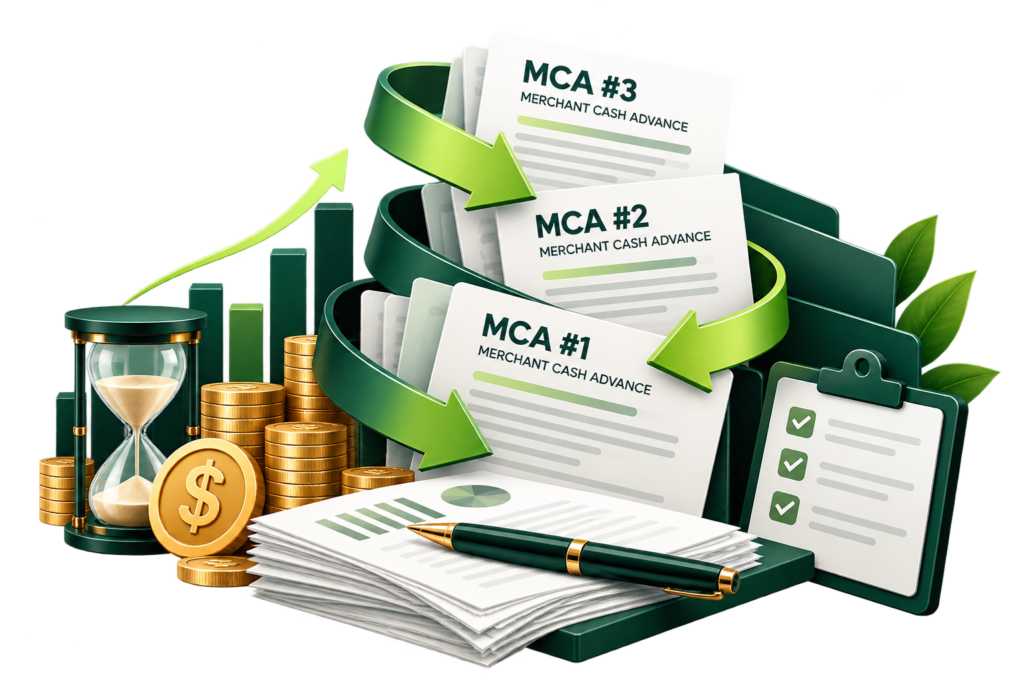
MCA stacking is a common term for taking a new merchant cash advance while one or more earlier advances are still being repaid. For example, MCA #1 is still being repaid when MCA #2 is taken, and MCA #3 is added while both remain outstanding. The result can be several funders collecting payments from the same business revenue at overlapping times.
The term “stacking” describes the financing pattern. It does not, by itself, determine whether an agreement is valid, whether a contract has been breached, or what options may be available. Each MCA has its own agreement, payment structure, balance calculation, and contractual terms.
Put simply, stacking means adding another advance while an earlier advance remains outstanding, so multiple payment streams draw on the same business cash flow.
MCA stacking often develops because a business needs additional working capital while an existing advance is still being repaid.
A business takes an MCA to address a working-capital need.
The required remittance reduces the cash available for normal operations.
Revenue changes, expenses increase, or another business need creates a funding gap.
The business accepts another advance while the first remains active.
The business now has more than one payment obligation drawing from the same revenue stream.
The combined payments may leave less cash available for payroll, suppliers, inventory, rent, or other operating needs.
This doesn’t mean every second-position MCA is automatically unmanageable. The actual effect depends on the business’s revenue, expenses, payment obligations, and the terms of each agreement.
The core issue is simple:
The business does not get a second revenue stream just because it takes a second advance. The same business revenue is now supporting multiple obligations.
Picture business revenue being split three ways between MCA #1, MCA #2 and MCA #3 before anything is left for payroll, suppliers, inventory and rent.One payment may be manageable. Two or three overlapping withdrawals can change the amount of cash available for ordinary business expenses. The practical issue with stacking is the combined daily or weekly withdrawal burden against the same revenue base.
Having multiple advances is not automatically a crisis. Look at the combined financial picture.
Two or more MCA companies are withdrawing money from the same business account.
Daily or weekly payment schedules occur during the same period.
Less money remains after MCA payments for ordinary business expenses.
New funding was taken while an earlier MCA was still active because existing cash flow wasn’t enough.
Sales have declined, become seasonal, or are arriving later than expected.
The business is struggling to maintain one or more required withdrawals.
These signs do not establish a particular legal or contractual outcome. They simply indicate that the combined payment picture deserves closer review.
These terms are closely connected, but they are not interchangeable.
| MCA Stacking | Multiple MCA Debt |
|---|---|
| Focuses on overlapping advances | Focuses on having several active MCAs |
| Explains how another MCA was added | Examines the combined debt burden |
| Focuses on the pattern of borrowing | Focuses on the overall payment picture |
| Looks at timing between advances | Looks at balances, payments and frequency |
| Explores contractual considerations | Explores potential debt-management paths |
Put simply:
If you have several advances, you can read the related page:
Start by creating a simple list of every active advance.
Who provided or currently services the advance?
When was the advance entered into?
How much was initially provided, if known?
How much is being withdrawn?
Daily, weekly, or another schedule?
What do you believe remains outstanding?
Current, missed, returned, disputed, or otherwise difficult to maintain?
Are there provisions concerning additional financing, reconciliation, payment requirements, default, or other relevant matters?
How do the combined payments affect cash available for operations?
Some MCA agreements contain anti-stacking or no-additional-debt provisions. These provisions may restrict a business from taking additional financing while an existing advance is outstanding without the provider’s approval. Whether such a provision exists, what it covers, and what happens if it is violated depends on the specific contract. Anti-stacking clauses commonly restrict additional MCA financing or other debt without the funder’s prior approval.
So don’t assume:
“I took another MCA, therefore I automatically defaulted.”
Instead:
Review the agreement and determine what the contract actually says.
If you’re unsure how a provision applies to your situation, a qualified attorney can review the contract and explain the legal implications.
When cash flow becomes tight, another advance can look like a quick way to create breathing room. But it also creates another obligation.
Before taking another MCA, compare:
The important question isn’t simply:
“Will this give me cash today?”
It is:
“Will the new obligation improve the overall cash-flow picture after considering all existing payments?”
Using a new advance to service existing advances can increase the number of payment obligations rather than resolve the underlying cash-flow issue.
There isn’t one universal solution for every stacked MCA situation. Depending on the agreements and business circumstances, several areas may be worth reviewing.
Start with the combined payment picture. How much is being withdrawn each day or week, and how does that compare with actual business revenue and essential expenses? This can help establish whether the primary issue is payment frequency, payment size, revenue timing, or broader overextension.
Some MCA agreements include reconciliation provisions that may allow payment calculations to be reviewed against actual business receipts. Whether reconciliation is available and how it operates depends on the specific agreement. A reconciliation request should not automatically be described as debt forgiveness or settlement.
Depending on the circumstances, a business may explore whether revised payment terms are available. Potential changes could involve payment amount, frequency, or duration. However: A lower periodic payment does not automatically mean a lower total cost. The full proposed arrangement should be reviewed before agreeing to changes.
A business may explore whether its MCA obligations can be negotiated or settled under agreed terms. A settlement may involve resolving an obligation for an agreed amount or payment arrangement. There is no universal settlement percentage or guaranteed outcome. Each funder may respond differently based on the agreement, payment history, business circumstances, and proposed terms.
In some circumstances, a business may investigate refinancing or consolidation. But a new financing arrangement should be compared against the entire existing debt picture. A lower periodic payment can sometimes come with a longer repayment period, additional costs, or another obligation. Genuine consolidation that pays off existing advances is different from “reverse consolidation” arrangements that add new financing while existing obligations remain.
A case assessment does not guarantee:
Use the short assessment to tell us how many MCAs are active, their approximate payment amounts and frequency, and what is creating the most pressure.
Our team reviews the information to understand the general stacking situation and the business’s payment pressure.
Where appropriate, we may determine that a resolution team could be suited to review the number of advances, debt size, state, and payment circumstances.
Having your case assessed does not obligate you to enroll in a program. Any resolution team fees and terms should be explained before you agree to services.
MCA Resolution is not a law firm or debt settlement company. We assess your case and the right resolution team takes it forward. It does not negotiate with funders or restructure business debt itself and may receive compensation from resolution teams.
Straight answers to the questions business owners ask us most. Still unsure? Talk to our team.
MCA stacking is a common term for taking a new merchant cash advance while one or more earlier advances are still being repaid. This can result in multiple payment obligations drawing from the same business revenue.
Not necessarily. The term itself does not determine legality or contractual validity. Some MCA agreements contain provisions restricting additional financing, so the specific contract and circumstances matter.
Not automatically. Some agreements may treat additional financing as a default event, while the exact terms vary. Review the applicable agreement rather than assuming a particular outcome.
Businesses may seek another advance when they need working capital while an existing advance is still outstanding. A new advance can provide immediate liquidity but also creates another repayment obligation.
They’re related but different. MCA stacking describes the overlapping-financing pattern, while multiple MCA debt focuses on the overall burden of having several active advances.
Potentially. Depending on the circumstances, a business may explore negotiation, restructuring, reconciliation, or settlement. No particular outcome is guaranteed.
It may be possible to explore a coordinated approach, but each funder and agreement is different. A resolution team would need to review the specific obligations before determining whether a coordinated resolution is appropriate.
Possibly, if the applicable agreement contains a reconciliation provision and its requirements are met. Reconciliation is contract-specific and should not automatically be presented as debt reduction.
Before adding another obligation, compare the proposed financing with your existing payment burden, total cost, repayment period, and operating cash flow. Another advance may add payment pressure rather than solve the underlying problem.
Start by mapping every active advance: funder, payment, frequency, estimated balance, contract terms, and current status. That gives you a clearer picture for a professional review.
No. MCA Resolution Advisory assesses your case and makes sure the right resolution team assists you. Where appropriate, it may connect a business owner with a resolution team for further review.
Multiple advances can make it difficult to see the full financial picture. Start by listing your active MCAs, payment amounts and frequency, then tell us how those obligations are affecting your business.