01
Why fixed debits create pressure
If sales fall but the fixed debit stays the same, a larger share of each day’s revenue goes to the funder. That can leave less cash for payroll, inventory, rent and suppliers.
MCA payment reduction involves reviewing your current repayment structure and exploring whether a different payment arrangement may be possible based on your business circumstances. Whether you’re managing one MCA or multiple obligations, the first step is understanding your current payment burden and available options.
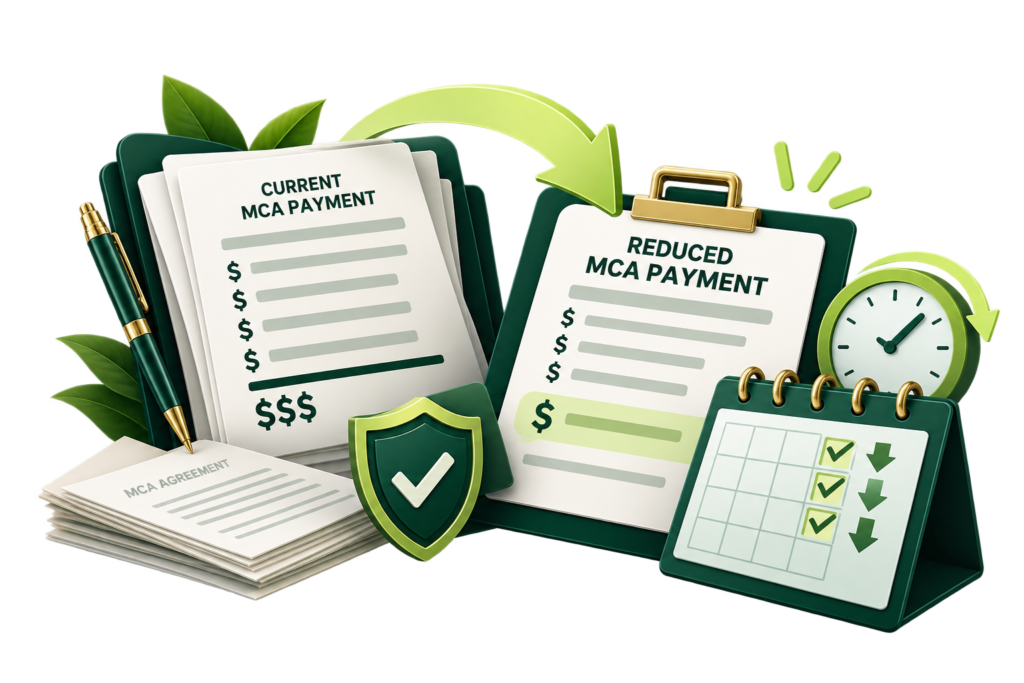
MCA payments can sometimes be adjusted, but a reduction is not automatic or guaranteed.
Depending on the agreement and circumstances, potential approaches may include reconciliation, negotiation, payment restructuring, or other resolution options.
The appropriate path can depend on your current payment amount, payment frequency, revenue, remaining obligation, business cash flow, and the funder’s willingness to modify the arrangement. Reconciliation, negotiation and restructuring are the most common routes to lower periodic payments.
Many MCA agreements describe repayment as a percentage of receivables, often called a holdback. In practice, many funders collect a fixed daily or weekly ACH amount that is estimated from past sales.
If sales fall but the fixed debit stays the same, a larger share of each day’s revenue goes to the funder. That can leave less cash for payroll, inventory, rent and suppliers.
Some agreements allow the business to request that the debit be adjusted to reflect actual receivables. The process, the records required and the funder’s obligations depend on the contract.
Recent bank statements, processing statements and a simple record of revenue over the last few months make it easier to show how your sales have changed.
You may want to review your payment options when your current MCA withdrawals are putting pressure on normal business operations.
Frequent withdrawals leave less cash available for essential operating expenses.
Several advances can create overlapping daily or weekly payment obligations.
Your current revenue may no longer support the payment structure established when the MCA began.
MCA withdrawals are competing with payroll, inventory, rent, suppliers, or taxes.
Your business may experience periods when revenue temporarily falls below normal levels.
Taking new financing to cover existing payments can add another obligation to the business.
A review does not guarantee that a payment reduction will be available.
There isn’t one universal method for lowering MCA payments. The available approach depends on the agreement and business circumstances.
Some MCA agreements may contain reconciliation provisions that allow payment calculations to be reviewed against actual receivables or revenue.
Whether reconciliation is available, and how it works, depends on the specific contract and applicable circumstances.
A business may discuss its current payment arrangement with the funder and explore whether modified terms are possible.
This may involve the payment amount, schedule, timing, or other terms.
Restructuring may involve changing the repayment schedule or extending the period over which payments are made.
A lower periodic payment can provide additional cash-flow flexibility, but it may also change the total repayment cost.
Depending on the circumstances, payment reduction may be considered alongside settlement or other business debt solutions.
The appropriate option depends on the overall financial situation rather than one payment alone.
Your payment situation matters more than a generic percentage.
What are you paying each day or week?
How often are withdrawals being made?
What balance or repayment obligation remains?
How much revenue is currently coming into the business?
What must the business cover before debt payments?
Are other MCAs creating additional payment pressure?
A reduced daily or weekly payment can create more room in your business’s operating cash flow. But a lower periodic payment is not the same as a lower total repayment. Changing a payment structure could involve a longer repayment period, additional fees or different terms. Before accepting any revised arrangement, always review the total repayment, the duration, the fees and the other terms.
For a general look at building a cash-flow picture, see the FDIC’s free guide (PDF).
When multiple merchant cash advances are active, each funder may withdraw according to a separate schedule.
For example, one advance might withdraw daily, a second might withdraw daily at a different amount, and a third might collect weekly.
Each schedule may look manageable on its own. Together, they can consume much of the cash a business needs to operate.
MCA stacking and multiple MCA obligations can make the total payment burden more difficult to manage, which is why the review should consider all active obligations together.
These are not the same thing.
| Option | Primary Goal |
|---|---|
| Payment Reduction | Seek a more manageable periodic payment |
| MCA Negotiation | Discuss potential changes to existing terms |
| Payment Restructuring | Modify the repayment structure or schedule |
| MCA Settlement | Seek an agreed resolution of an outstanding obligation |
A payment reduction may change how much is paid at a time, while a settlement focuses on resolving an obligation under agreed terms.
A payment reduction therefore does not automatically eliminate or reduce the underlying balance.
Exploring payment relief does not automatically guarantee:
Every payment arrangement depends on the specific agreement, business circumstances, funder participation, and terms ultimately accepted.
If your business has received legal papers or you have questions about your legal rights, guarantees, liens, or disputes, consult a qualified attorney.
Tell us about your business, current MCA payments, and payment pressure.
We review your case to understand the overall payment picture and which resolution team is best placed to assist you.
Where appropriate, a dedicated resolution team can discuss potential payment adjustment or resolution paths with you.
Before proceeding, review the applicable process, terms, costs, and responsible service provider.
Straight answers to the questions business owners ask us most. Still unsure? Talk to our team.
They can sometimes be adjusted through reconciliation, negotiation, restructuring, or another arrangement, but a reduction is not guaranteed.
Potential approaches may include reviewing reconciliation rights, negotiating revised terms, restructuring payments, or exploring other debt-relief options based on your circumstances.
Potentially. Payment restructuring and settlement are different approaches. A payment change does not necessarily resolve the full underlying obligation.
Not necessarily. A lower periodic payment may extend the repayment period or change other terms, so the total cost should be reviewed carefully.
Multiple MCA obligations can be reviewed together, but each agreement and funder may have different terms and responses.
Reconciliation may allow certain MCA payments to be reviewed against actual receivables when the applicable agreement provides for it. The specific contract determines whether and how it applies.
No. An assessment or request does not automatically change your existing payment obligations. Do not assume payments have stopped unless an applicable agreement confirms a change.
There is no universal timeline. Timing depends on the information available, the parties involved, the complexity of the situation, and whether revised terms are accepted.
Useful information can include current payment amounts, payment frequency, MCA agreements, balances, recent revenue, operating expenses, and other MCA obligations.
Complete the Free MCA Debt Assessment and tell us about your current MCA payments and business situation.
No. The initial assessment is free and there is no obligation. MCA Resolution Advisory never charges merchants a fee; any resolution team will explain its own fees and terms in writing before you decide.
Start by understanding your current payment structure and what options may be available. Tell us about your MCA payments, business cash flow and current challenges.