
01
Missed or Returned Payment
A scheduled daily or weekly payment is not successfully processed.
Missed an MCA payment, received a default notice, or concerned that your business may be heading toward default? Start by understanding the agreement, payment history, and options available for review. Free initial assessment. No obligation. No bank credentials, account numbers, Social Security numbers or document uploads are required.
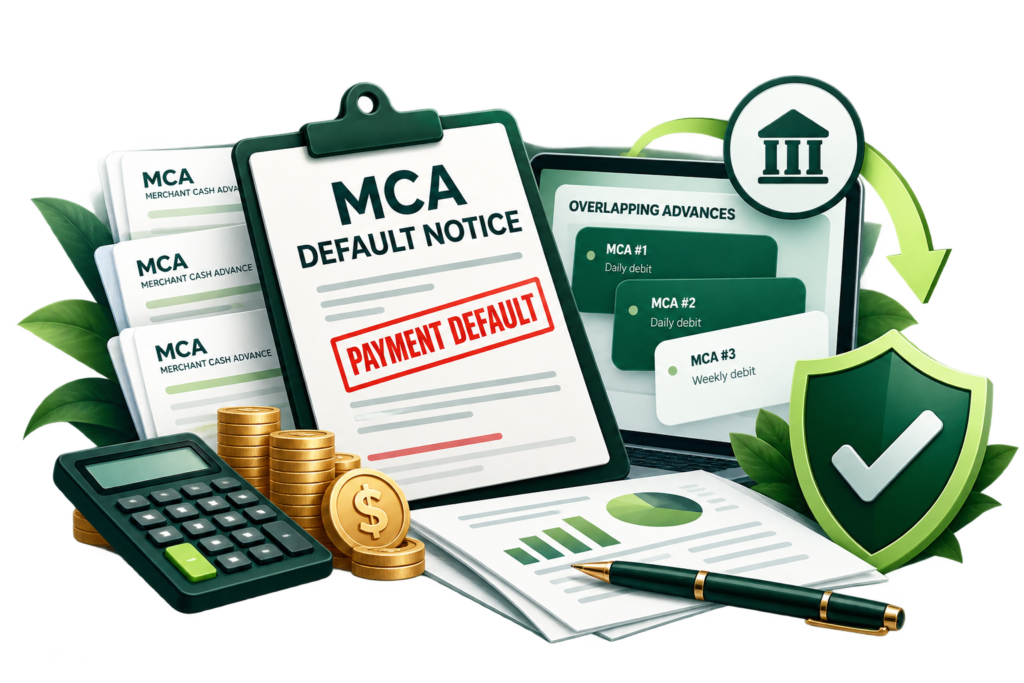
An MCA default generally means that an event identified in the merchant cash advance agreement as a default has occurred. A missed or returned payment may be one trigger, but it is not necessarily the only one. Depending on the agreement, other events may also be treated as defaults, including certain payment interruptions, contractual breaches, or prohibited actions.
The Consumer Financial Protection Bureau’s explanation of merchant cash advances provides background on these arrangements. However, what constitutes an MCA default depends on the specific agreement and circumstances.
Because MCA agreements differ, it is important to review the specific agreement rather than assume that every funder follows the same process. Default is a contractual issue, not a universal timeline. What happens next can depend on the funder, agreement, payment history, guarantees, and other circumstances.
Different MCA agreements can define default differently.
Common issues that may require review include:
A scheduled daily or weekly payment is not successfully processed.
Repeated failed withdrawals or other interruptions may create concerns under the agreement.
The agreement may identify specific actions or circumstances as events of default.
Some agreements contain provisions restricting additional financing while an existing advance remains outstanding.
Guarantees, representations, financial requirements, and other contractual provisions may also matter.
Important: These are examples, not a universal list. The actual MCA agreement should determine what constitutes default in a particular situation.
There is no single sequence that applies to every MCA. A missed payment may lead to communication from the funder, additional payment attempts, a request for information, or a formal notice. Depending on the agreement and circumstances, a funder may later assert contractual remedies or pursue collection or legal action.
A simple way to understand the process is:
A simple way to understand the process: a missed payment, then funder communication, a review of the agreement, a potential default notice, and finally a possible resolution or collection path. The important point is that a missed payment should not automatically be treated as proof of what will happen next. Your agreement and current circumstances matter.
If payments have already become difficult, organize the situation before making assumptions about your options.
Identify which payments were missed, returned, or changed.
Record the normal daily or weekly amount being withdrawn.
Review the amount the funder currently claims is outstanding.
Look for default provisions, reconciliation language, payment terms, and other relevant clauses.
Keep copies of emails, letters, default notices, and collection communications.
Consider how the MCA payment is affecting payroll, suppliers, inventory, rent, and other operating expenses.
If multiple advances are active, list each payment separately.
If you receive a lawsuit, court notice, or other formal legal document, keep it and seek appropriate legal advice promptly.
Potentially, depending on the agreement and circumstances.
Several approaches may be worth exploring before deciding what happens next.
Some MCA agreements contain reconciliation provisions that may allow payment amounts to be reviewed against actual business receipts. A reconciliation request does not automatically guarantee that payments will be reduced. The specific contract and financial records matter.
Depending on the funder and circumstances, the payment schedule or other terms may be discussed. A lower periodic payment can improve short-term cash flow, but it does not necessarily reduce the total amount owed.
A funder may be willing to discuss different repayment terms or another resolution depending on the circumstances.
In some situations, settlement may be explored as an alternative to continuing the existing payment arrangement. There is no universal settlement percentage or guaranteed outcome; terms depend on the individual file and funder’s position.
Default becomes more complicated when a business has several active MCAs. For example, two advances collecting daily and a third collecting weekly create combined payment pressure that is harder to absorb after a missed payment. If you have multiple advances, don’t look at each payment in isolation.
Review:
This is also where our Multiple MCA Debt page can provide more context.
A default notice is important information about the funder’s position, but it does not by itself tell you what the final outcome will be.
Start by reviewing:
Keep the notice and related communications organized. If the matter involves a lawsuit, court deadline, judgment, or other legal proceeding, consider speaking with a qualified attorney about your specific situation.
Legal involvement changes the situation. Depending on the agreement, applicable law, and stage of the matter, a funder may pursue contractual or legal remedies after default. The precise process varies and should not be assumed from another business owner’s experience.
If you have received:
Do not ignore the deadline stated in the document.
MCA Resolution Advisory is not a law firm. Where a situation requires legal advice, a qualified attorney should be consulted. Some MCA agreements include a confession of judgment or other provisions that can move quickly, so act promptly on any legal deadline.
Once the current situation is understood, several paths may be worth reviewing.
| Option | What It Focuses On |
|---|---|
| Reconciliation Review | Whether payment terms can be reviewed against actual receipts under the agreement |
| Payment Restructuring | Whether a different payment arrangement may be possible |
| MCA Debt Negotiation | Whether different repayment terms can be discussed |
| MCA Debt Settlement | Whether a negotiated resolution may be available |
| Multiple MCA Review | How several advances interact with the business’s overall cash flow |
These are potential paths, not guaranteed outcomes. Reconciliation, restructuring or renegotiation, settlement, and financing review are all possible approaches, but the available path depends on the individual circumstances.
A useful MCA default review starts with the facts.
The relevant contract and payment provisions.
Whether a payment was missed, returned, or formally declared in default.
The current daily or weekly payment burden.
Approximate balances or purchased amounts being claimed.
Any additional MCAs affecting the business.
How current obligations interact with operating revenue and expenses.
A case assessment does not guarantee:
Every MCA situation is different.
Share the basic details about your MCA, payment situation, and current concern.
Our team reviews the information you provide and considers the type of issue involved.
Where appropriate, we may connect you with a debt resolution team for further review.
The resolution team can explain its services, process, fees, and potential options before you decide whether to move forward.
MCA Resolution Advisory does not directly negotiate or settle MCA debt.
We assess every case independently, and the assessment is free for business owners. We never charge merchants a fee.
Straight answers to the questions business owners ask us most. Still unsure? Talk to our team.
An MCA default generally means an event identified as a default under the merchant cash advance agreement has occurred. The specific definition depends on the contract.
A missed payment may lead to additional payment attempts, communication from the funder, a default notice, or other contractual actions. The exact response varies by agreement and funder.
Not necessarily. The answer depends on the terms of your specific MCA agreement and what the funder considers an event of default.
There is no universal answer. Depending on the circumstances, the parties may discuss payment adjustments, reconciliation, restructuring, settlement, or another resolution. A specific outcome cannot be guaranteed.
Potentially, depending on the agreement, funder, financial circumstances, and proposed resolution. A lower payment also does not necessarily mean a lower total repayment cost.
It may be worth reviewing if the MCA agreement contains a reconciliation provision. Whether it applies depends on the actual contract and financial records.
Taking another advance can add another payment obligation and should not be treated as an automatic solution. Review the new funding amount, net proceeds, payment, frequency, total repayment, existing obligations, and business cash flow before making a decision.
Multiple defaults require a broader review of the advances, payment obligations, agreements, and overall business cash flow. This is where a Multiple MCA Debt review may be relevant.
Keep the documents and pay close attention to any response deadline. MCA Resolution Advisory is not a law firm, so legal questions about a lawsuit should be directed to a qualified attorney.
No. MCA Resolution Advisory assesses your case and makes sure the right resolution team assists you. Where appropriate, we may connect a business owner with a resolution team that can explain its services and potential options.
A missed payment or default notice can make it difficult to see your next step. Start by organizing your MCA agreements, payment information, notices and current cash-flow situation, then tell us what is happening.