01
Payments Are Too High
Current debt payments leave too little cash for essential operating expenses.
Struggling with business debt payments that leave little room for daily operations? Business debt restructuring may help reorganize payment schedules and repayment terms to better fit your cash flow. At MCA Resolution, we review your obligations and connect you with a resolution team to explore potential options. Start with a free, no-obligation assessment.
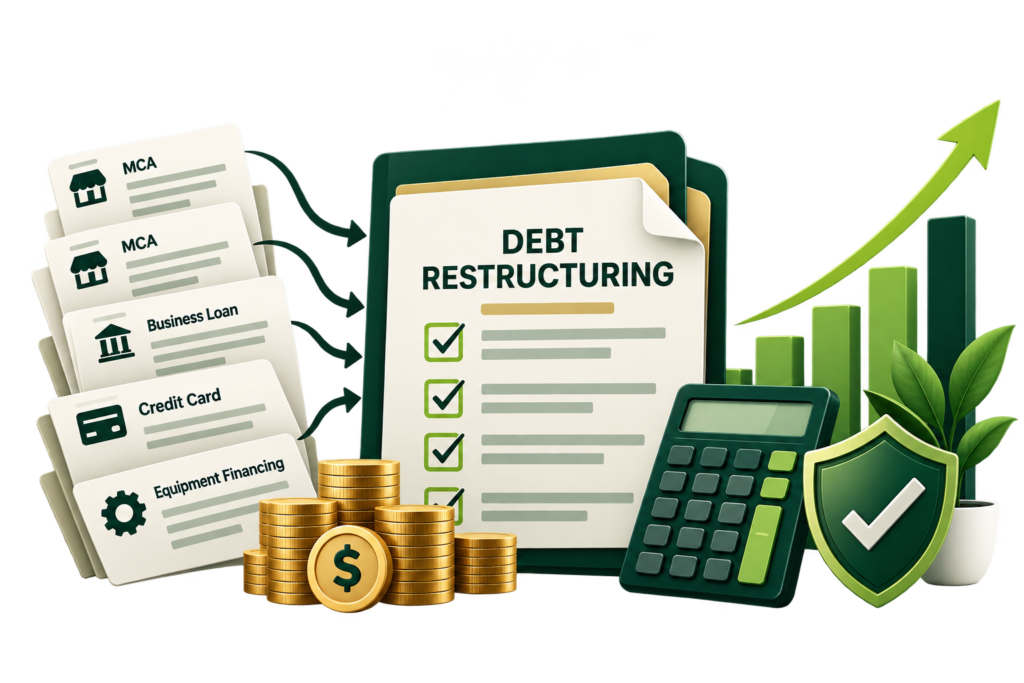
Business debt restructuring involves exploring whether existing debt obligations can be reorganized into terms that better align with a business’s current financial situation. Depending on the type of obligation, restructuring may involve changes to the payment amount, payment frequency, repayment schedule, or other terms.
For an MCA, for example, a restructuring proposal may involve changing the periodic payment or extending the time available to satisfy the obligation. However, the funder must agree to any revised arrangement, and the original agreement should be reviewed before assuming a change is available.
Restructuring may be worth exploring when the business can continue operating but its existing debt structure is creating too much pressure.
Current debt payments leave too little cash for essential operating expenses.
Daily or weekly withdrawals do not align well with the business’s actual revenue cycle.
Sales have declined, become seasonal, or become less predictable since the debt was originally arranged.
Several business debts are drawing from the same available cash flow.
The business may be able to repay its obligations, but the current structure is difficult to maintain.
The business needs more predictable repayment requirements to manage payroll, suppliers, inventory, rent, or other expenses.
The specific changes depend on the creditor, contract, and financial circumstances.
A daily payment arrangement may potentially be changed to a different schedule when the creditor agrees.
The repayment timeline may potentially be extended or reorganized.
A revised structure may reduce the periodic payment while changing the duration or other terms.
Certain obligations may be reorganized into a different agreed repayment arrangement.
The key is to evaluate the complete proposed arrangement, not just the new payment amount: what changes, what stays the same, how long payments continue, and the resulting total cost.
Merchant cash advances can create particular cash-flow challenges because payments may be collected frequently. For businesses carrying one or more MCAs, restructuring discussions may involve reviewing:
A restructuring arrangement may seek to make the payment structure more manageable while allowing the business to continue operating. However, MCA restructuring is not automatic. The availability of revised terms depends on the specific agreement, business circumstances, and funder participation.
When a business has several MCAs or other commercial obligations, the problem may not be a single payment. It may look more like:
For example, two or three MCAs plus a business loan or credit card can all draw on the same revenue, so combined debt payments reduce the cash left to operate. This is why restructuring should consider the overall debt picture, rather than focusing on one obligation in isolation.
MCAs, business credit cards, lines of credit and other commercial obligations are best reviewed together as one combined debt picture. Learn more about MCA stacking.
These terms are often used interchangeably in the industry, but they describe different concepts.
| Option | Primary focus |
|---|---|
| Business Debt Restructuring | Reorganizing existing repayment terms or structure |
| MCA Payment Reduction | Exploring whether periodic payments can become more manageable |
| MCA Debt Settlement | Seeking an agreed resolution of an outstanding obligation |
| Debt Negotiation | Discussing potential changes with a creditor or funder |
For example, restructuring may change how and when a business pays, while settlement may concern what amount or terms are used to resolve an obligation. See MCA debt settlement and MCA payment reduction.
You don’t need every number to the exact dollar before starting an initial review.
What business obligations are currently outstanding?
How much is being withdrawn or paid?
Daily, weekly, monthly, or another schedule?
Approximately how much remains?
What does the business currently generate?
What does the business need to maintain normal operations?
A restructuring discussion should always consider the relationship between debt payments and operating cash flow.
Under the current structure, revenue comes in, debt payments are withdrawn first, and payroll, suppliers and operating expenses compete for what remains. If debt payments consume too much available cash, the business can struggle even when revenue continues coming in.
Under a revised structure, revenue comes in, revised debt payments are withdrawn, and operating cash flow may become more predictable.
This is not a guarantee that restructuring will be approved or improve the business’s financial position. It simply illustrates why payment structure matters alongside the total amount owed.
A restructuring inquiry does not guarantee:
Any revised arrangement should be reviewed carefully before it is accepted.
Provide basic information about your business, obligations, and current payment pressure.
Our team reviews the information you provide to understand the overall debt picture.
Where appropriate, we may connect you with a dedicated resolution team that can discuss potential paths.
You can review the information, ask questions, and decide whether you want to move forward.
MCA Resolution is not a law firm or debt settlement company. We assess your case and the right resolution team takes it forward. Where appropriate, inquiries may be connected with resolution teams that provide specialized debt-resolution services.
Before you sign anything, make sure you can answer these questions about the proposed terms.
Compare the total you would pay under the revised terms with what remains under the current agreement.
A longer schedule can lower each payment while extending the period your business is committed.
Ask for every fee in writing, including any charged by a service provider, and when each one is due.
Ask whether the revised arrangement allows for future adjustments, reconciliation or communication if business conditions change.
Straight answers to the questions business owners ask us most. Still unsure? Talk to our team.
Business debt restructuring involves exploring changes to existing debt arrangements so the repayment structure may better fit the business’s current circumstances.
It may potentially change the periodic payment, but there is no guaranteed reduction. A lower payment can also involve a longer repayment period or different total cost.
MCA obligations may sometimes be restructured when the funder agrees to revised terms. Availability depends on the agreement and circumstances.
No. Restructuring generally focuses on changing the repayment structure, while settlement concerns an agreed resolution of an outstanding obligation.
Multiple obligations can be reviewed together, although each creditor or funder may have separate agreements and requirements.
Not necessarily. Restructuring may primarily change payment terms or timing rather than eliminate part of the underlying obligation.
A revised arrangement may potentially change payment collection, but an inquiry does not automatically stop withdrawals. Any change should be confirmed in writing with the relevant funder.
Not necessarily. A business can explore its options when payments are becoming difficult, although eligibility and available strategies vary.
Complete the free assessment with basic information about your business and current obligations. The information can then be reviewed to determine the appropriate next step.
There is no fixed timeline. It depends on the number of creditors or funders involved, how quickly information is gathered, and whether the parties agree on revised terms.
Start with a clearer picture of your current obligations, payment pressure and potential options. Tell us what is happening with your business debt, and we’ll review your inquiry.