01
Merchant Cash Advances
Business financing arrangements that may involve daily or weekly payment obligations.
Struggling with multiple business debts that are putting pressure on your cash flow? Commercial debt relief may involve negotiation, restructuring, or settlement options based on your obligations. At MCA Resolution, we review your situation and connect you with an appropriate resolution team. Start with a free, no-obligation assessment.
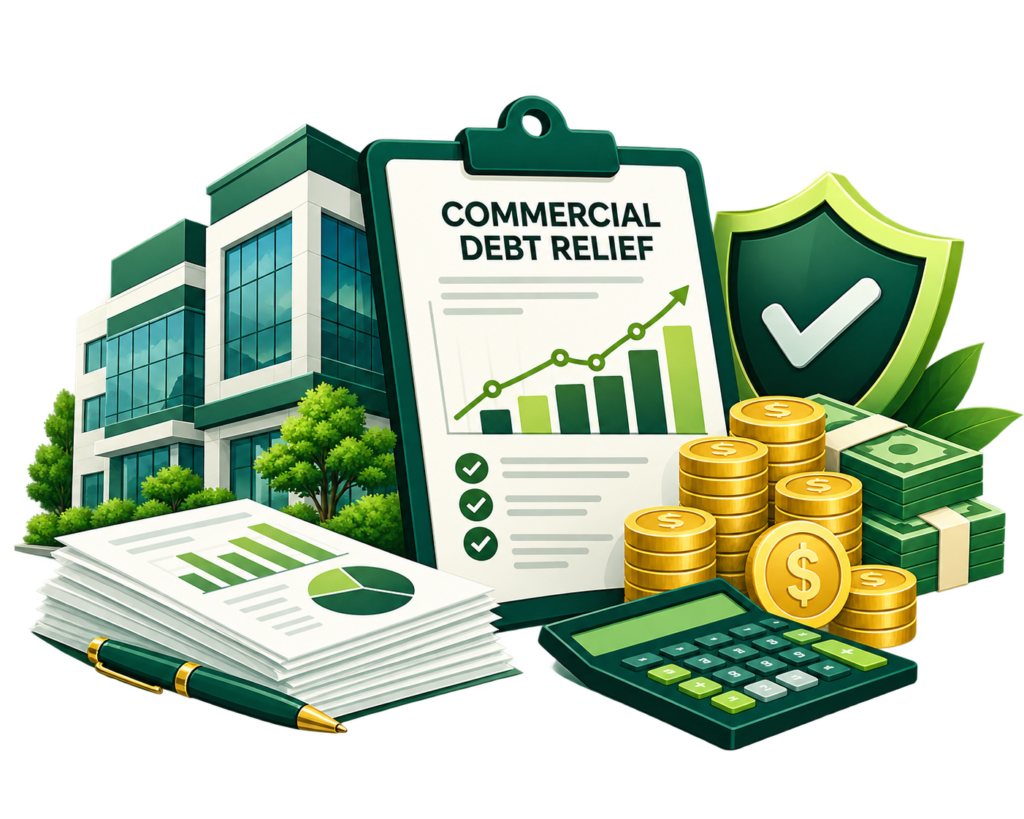
Commercial debt relief refers broadly to strategies, such as negotiation, restructuring, settlement or consolidation, that may help a business address commercial obligations that have become difficult to manage.
Depending on the type of debt and the agreement involved, potential approaches can include:
There is no universal commercial debt solution.
A business carrying one equipment loan has a different situation from a company managing several MCAs, business credit cards, a line of credit, and other commercial obligations.
That’s why a useful review starts with the business, the obligations, the payment structure, and the effect on operating cash flow.
Commercial debt generally refers to financial obligations connected to a business rather than ordinary personal or household debt.
Business financing arrangements that may involve daily or weekly payment obligations.
Term loans and other financing used for business purposes.
Revolving commercial balances that may create recurring payment obligations.
Business credit facilities that can affect available working capital and repayment capacity.
Financing or leases connected to business equipment and assets.
Depending on the situation, a business may also have vendor balances, commercial leases, or other business-related liabilities. The specific terms and legal treatment can differ significantly between debt types.
A business does not necessarily need to be in default before reviewing its options.
Debt payments are making it harder to cover payroll, inventory, suppliers, rent, or other essential expenses.
Several creditors or funders are drawing from the same business revenue.
Sales have declined, become seasonal, or become less predictable.
Too much available cash is being committed to debt payments rather than business operations.
The current repayment structure may no longer align with how the business actually receives revenue.
You want to review the commercial debt picture before making another financing or repayment decision.
There is no single approach that applies to every business. Depending on the obligations involved, several strategies may be worth exploring.
Discuss whether a creditor or funder may consider changes to existing terms or payment arrangements.
Explore whether payment schedules, frequency, duration, or other repayment terms may be reorganized. A lower periodic payment does not automatically mean a lower total repayment cost.
Explore whether a creditor or funder may consider an agreed resolution of an outstanding obligation. Settlement terms vary and are never guaranteed.
Where appropriate, a business may evaluate whether replacing multiple obligations with another financing structure is feasible. This requires careful comparison of eligibility, repayment terms, fees, duration, and total cost. A new financing arrangement is not automatically better simply because it combines several payments.
Understand how commercial debt payments interact with revenue and operating expenses. A business may have enough revenue on paper while still experiencing significant cash-flow pressure because of payment timing.
Commercial debt doesn’t exist separately from the business. The payment structure can affect how much cash remains available for everyday operations. Revenue comes in, commercial debt payments are made, and payroll, suppliers, inventory, rent and operations are funded from what remains.
When scheduled payments consume too much available cash, a business can have difficulty maintaining normal operations even when revenue continues. That’s why commercial debt should be reviewed alongside cash flow, not only the total amount owed. Reviewing operating expenses, outstanding liabilities, and available cash flow can help business owners better understand their financial position. The SBA guidance on managing business finances provides additional resources for tracking business income, expenses, and financial obligations.
Many businesses have more than one commercial obligation.
For example, a business could be carrying two MCAs, a business credit card, a line of credit and equipment financing at the same time. One obligation may appear manageable on its own while the combined payment schedule creates a much larger problem. Mapping the full debt structure before deciding which strategy may fit gives you a much clearer starting point.
If your business has several merchant cash advances, see Multiple MCA Debt for a more focused discussion.
The initial assessment is designed to create a clearer picture without requiring every detail upfront.
What was the commercial obligation used for?
Who is the obligation owed to?
What do you know about the current arrangement?
How much is being paid and how often?
What do you know about the remaining balance or commitment?
How is the obligation affecting the business’s available cash?
These terms overlap, but they focus on different questions.
| Commercial Debt Relief | Business Debt Solutions |
|---|---|
| Focuses on commercial obligations creating financial pressure | Broader overview of possible business-debt strategies |
| Looks at the business’s commercial debt picture | Explains different approaches |
| Can include negotiation, restructuring, settlement, or other options | Helps users understand which types of solutions may be relevant |
| More focused on debt relief circumstances | More educational/solution-oriented |
Think of it this way:
A case assessment does not guarantee:
The availability and effect of any strategy depend on the business’s circumstances, the applicable agreements, and the relevant creditor or funder’s response.
Complete the short assessment with basic information about your business and commercial debt situation.
Our team reviews the information you provide before following up.
Where appropriate, we may connect you with an independent debt resolution team for further discussion.
You can review the information, ask questions, and decide whether you want to move forward.
The initial assessment does not ask for bank credentials, account numbers, Social Security numbers or document uploads.
Straight answers to the questions business owners ask us most. Still unsure? Talk to our team.
Commercial debt relief refers broadly to strategies that may help businesses address commercial obligations that have become difficult to manage.
Commercial debt can include MCAs, business loans, business credit cards, lines of credit, equipment financing, vendor obligations, and other business-related liabilities.
The terms overlap. Business debt relief is the broader category, while commercial debt relief focuses specifically on obligations connected to business activity.
Some negotiated arrangements may result in different repayment terms or an agreed resolution, but no specific reduction is guaranteed.
Some restructuring or negotiation arrangements may potentially change periodic payments. A lower payment does not necessarily mean a lower total repayment cost.
Yes. Reviewing multiple obligations together can provide a clearer picture of the combined payment burden and its effect on operating cash.
Not necessarily. A business can explore its options when payments are becoming difficult, although available strategies depend on the circumstances.
No automatic protection is created by requesting an assessment. Collection activity and legal rights depend on the specific circumstances and agreements involved.
There is no automatic credit improvement from requesting or receiving debt-relief assistance. Credit outcomes depend on the specific obligations and how they are reported.
MCA Resolution Advisory is not a law firm or debt settlement company. We assess your case and the right resolution team takes it forward. Where appropriate, it connects business owners with resolution teams.
Understand your current obligations, payment pressure and potential next steps. Tell us about your business and commercial debt situation, and our team will review your inquiry.