01
Multiple MCA Debt
You have two or more active merchant cash advances and the combined payments are becoming difficult to manage.
MCA debt help starts with understanding what is actually creating the pressure. If one or more merchant cash advances are straining your business, a free review can help you see the problem clearly and the options that may be available. MCA Resolution helps business owners who are having difficulty managing one or more merchant cash advance obligations.
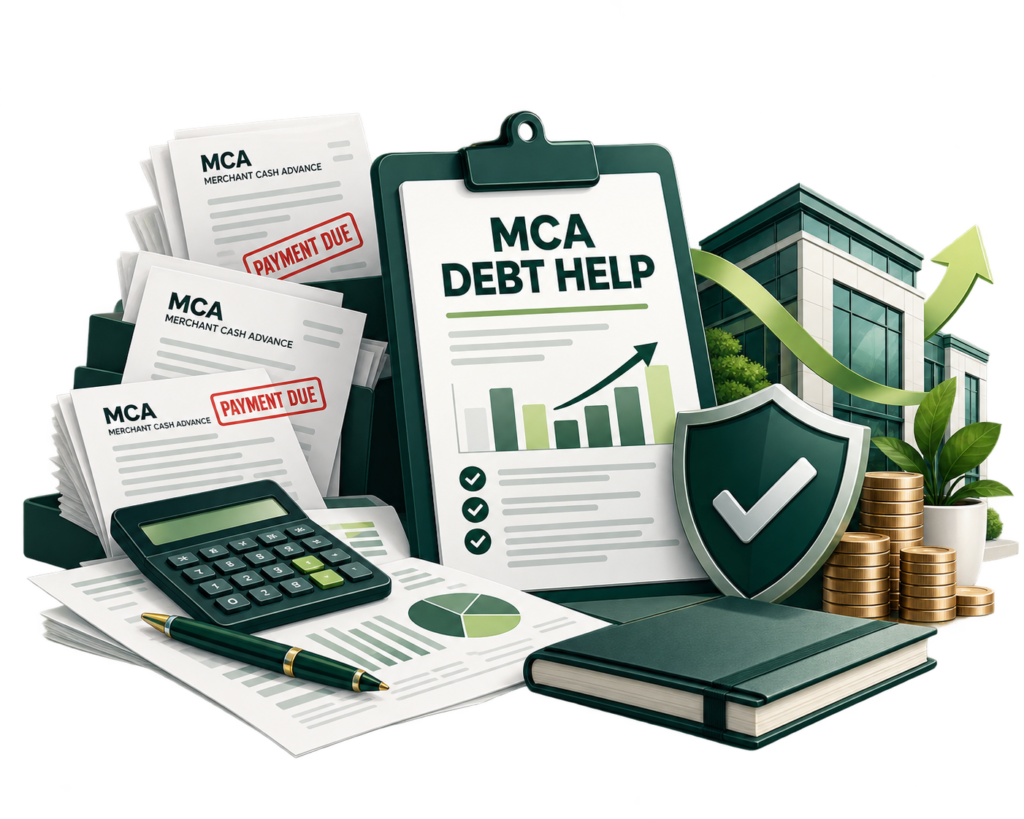
MCA debt help is a starting point for business owners who are having difficulty managing one or more merchant cash advance obligations. The issue may involve multiple advances, overlapping payment schedules, declining revenue, cash-flow pressure, missed payments, or concerns about what could happen if an MCA becomes difficult to maintain. There is no single solution for every business.
Depending on the agreements involved and the business’s circumstances, areas for review may include payment adjustments, reconciliation, restructuring, negotiation, settlement, or other business debt strategies. The first step is understanding what is actually creating the pressure.
MCA Resolution provides an initial review and, where appropriate, connects business owners with a debt resolution team. It does not itself negotiate with funders or restructure business debt.
You don’t necessarily need to know the name of a debt-relief service before asking for help. Start with the situation you recognize.
You have two or more active merchant cash advances and the combined payments are becoming difficult to manage.
You took another merchant cash advance while an earlier advance was still being paid.
MCA stacking describes overlapping advances, but the term itself does not determine whether a contract is valid or what relief may be available. Each agreement needs to be considered separately.
You have missed a payment, are struggling to maintain the required withdrawals, or are concerned that your business may default.
An MCA agreement can define default in different ways, so the specific contract and circumstances matter.
MCA problems don’t always begin with a missed payment. Sometimes the warning signs appear earlier.
Required withdrawals are leaving less money available for normal business expenses.
Several funders are collecting from the same business revenue.
Sales have slowed, become seasonal, or are arriving later than expected.
Payroll, suppliers, rent, inventory, fuel, or other essential expenses are competing with MCA payments.
Taking another advance to cover existing obligations may add another payment to the same revenue stream.
Payments have been missed, returned, disputed, or otherwise become difficult to maintain. Overlapping advances, declining or uneven revenue, and payment pressure are among the most common reasons MCA obligations become harder to manage.
A single MCA payment may look manageable when viewed by itself. The situation can change when several obligations are drawing from the same business revenue.
For example, business revenue may be split between MCA #1, MCA #2 and MCA #3 payments before payroll, suppliers, inventory and rent are covered, leaving very little remaining operating cash. The problem isn’t necessarily the number of MCAs alone.
It is the relationship between:
Looking at the combined payment burden is more useful than evaluating one advance in isolation.
There is no guaranteed outcome, and not every option will apply to every business. Depending on the agreements and circumstances, the following areas may be worth reviewing.
Start by identifying how much is leaving the business account and how frequently payments are being collected. This can help establish whether the current payment structure is contributing to the cash-flow problem.
Some MCA agreements may contain reconciliation provisions that allow payment calculations to be reviewed against actual business receipts. Whether reconciliation is available, how it works, and what documentation is required depend on the agreement and circumstances.
Restructuring may involve seeking changes to an existing payment arrangement. Learn more about business debt restructuring. Potential changes could involve payment amount, frequency, or repayment duration, but any modification requires the relevant funder’s agreement.
A lower periodic payment can improve short-term cash flow while potentially extending the repayment period or changing total cost, so the complete terms matter.
Negotiation may involve discussing payment terms or another resolution with an MCA funder. See MCA debt negotiation. The possible outcome depends on the agreement, payment history, business circumstances, and whether the funder agrees to the proposed terms.
Settlement involves reaching an agreement to resolve an obligation for an accepted amount or payment arrangement. See MCA debt settlement. Settlement is not automatic, and funder participation, available funds, timing, fees, and written terms all matter.
Multiple MCA debt and MCA stacking are closely related, but they are not exactly the same thing.
For a business with several active MCAs, a useful starting point is to list:
| Information | What to Identify |
|---|---|
| Funder | Who is collecting the payment? |
| Advance | Original amount or obligation |
| Payment | Daily or weekly amount |
| Frequency | How often money is withdrawn |
| Remaining balance | Approximate outstanding amount |
| Payment status | Current, missed, disputed, or other |
| Contract | Important terms or provisions |
Our MCA Stacking page goes further into the distinction between simply having multiple advances and the circumstances surrounding overlapping advances.
The consequences of payment problems depend heavily on the specific agreement and circumstances. An MCA default may involve more than a simple missed payment. Depending on the contract, default provisions may address payment failures, changes to payment methods or bank accounts, and other specified events.
That is why business owners should avoid assuming that:
“I’ll just stop the payments and figure it out later.”
Stopping, blocking, or changing ACH payments can have contractual consequences, and the effect varies by agreement. Changing ACH arrangements without understanding the contract can create additional problems. If your business has already received a lawsuit, legal notice or court deadline, contact a qualified attorney promptly. A debt-help assessment is not a substitute for legal counsel.
You don’t need every number perfectly calculated before starting an inquiry.
How many merchant cash advances are currently active?
What is being withdrawn from the business account?
Are payments being collected daily, weekly, or under another arrangement?
Are payments current, missed, disputed, or otherwise difficult to maintain?
How are the payments affecting money available for normal operations?
Is the biggest concern multiple MCAs, stacking, payment pressure, a missed payment, or uncertainty about what to do next?
Estimates or “Not sure” responses can be used when exact figures aren’t known. The initial form does not request bank credentials, account numbers, Social Security numbers or document uploads.
These two starting points overlap, but they answer different questions.
| MCA Debt Help | MCA Debt Relief |
|---|---|
| Starting point for an MCA problem | Broader relief-focused service category |
| Helps identify the situation | Explores potential debt-relief approaches |
| Covers multiple MCAs, stacking, and default concerns | Covers negotiation, payment reduction, settlement, restructuring, and recovery |
| Guides users toward the relevant service page | Goes deeper into potential relief strategies |
| Broad informational intent | More specific relief intent |
Think of MCA Debt Help as the entry point and MCA Debt Relief as the place to explore specific relief approaches. You don’t have to diagnose your problem before reaching out.
A case assessment does not guarantee:
An inquiry does not guarantee payment reduction, settlement, eligibility, or an agreement with a funder.
Complete the short assessment with basic information about your business and MCA situation.
Our team reviews the information to understand the general nature of the problem.
Depending on what you describe, the inquiry may relate to multiple MCA debt, stacking, payment pressure, default concerns, or another business debt issue.
Where appropriate, MCA Resolution Advisory may connect you with an independent debt resolution team that can review the situation in greater detail.
MCA Resolution Advisory is not a law firm or debt settlement company. We assess your case and the right resolution team takes it forward. It may be compensated by resolution teams and never charges merchants a fee.
Straight answers to the questions business owners ask us most. Still unsure? Talk to our team.
MCA debt help is a starting point for business owners experiencing difficulty with one or more merchant cash advances, including multiple advances, stacking, payment pressure, or default concerns.
You can begin by reviewing the combined number of advances, payment amounts, payment frequency, and outstanding obligations. Multiple MCA debt may require looking at the whole payment picture rather than one advance at a time.
MCA stacking generally describes taking another merchant cash advance while an earlier advance is still outstanding. The term describes the pattern but does not determine what contractual or relief options are available.
Start by reviewing the agreement, payment structure, cash-flow situation, and any existing payment problems. Do not assume that stopping or blocking payments has no consequences; the agreement may define missed or blocked payments as a default event.
Potentially, depending on the agreements, funders, business circumstances, and the provider involved. A review of all active obligations can help determine whether a coordinated approach may be appropriate.
A reduction is not guaranteed. Depending on the circumstances, a business may explore settlement, restructuring, reconciliation, or other approaches.
In some circumstances, payment terms may be modified or reconciled, depending on the agreement and funder’s acceptance. A lower payment does not necessarily mean a lower total repayment cost.
Not necessarily. Businesses can seek to understand their options before a default occurs. The appropriate path depends on the payment situation and agreements involved.
You can still start with estimates. The assessment lets you indicate when you are unsure about exact figures.
No. MCA Resolution Advisory assesses your case and makes sure the right resolution team assists you. Its role is to review the inquiry and, where appropriate, connect the business owner with a debt resolution team.
Whether you’re dealing with multiple advances, MCA stacking, payment pressure or concerns about default, you don’t need to have every answer before you ask. Tell us what is happening with your business.