01
Combined Payments Are Increasing
Several daily or weekly withdrawals are taking a growing share of available business cash.
Struggling with multiple merchant cash advances draining your business cash flow? Multiple MCA debt can create overlapping daily or weekly payments that make essential expenses harder to manage. At MCA Resolution, we review your combined obligations and connect you with an appropriate resolution team when needed. Start with a free, no-obligation assessment.
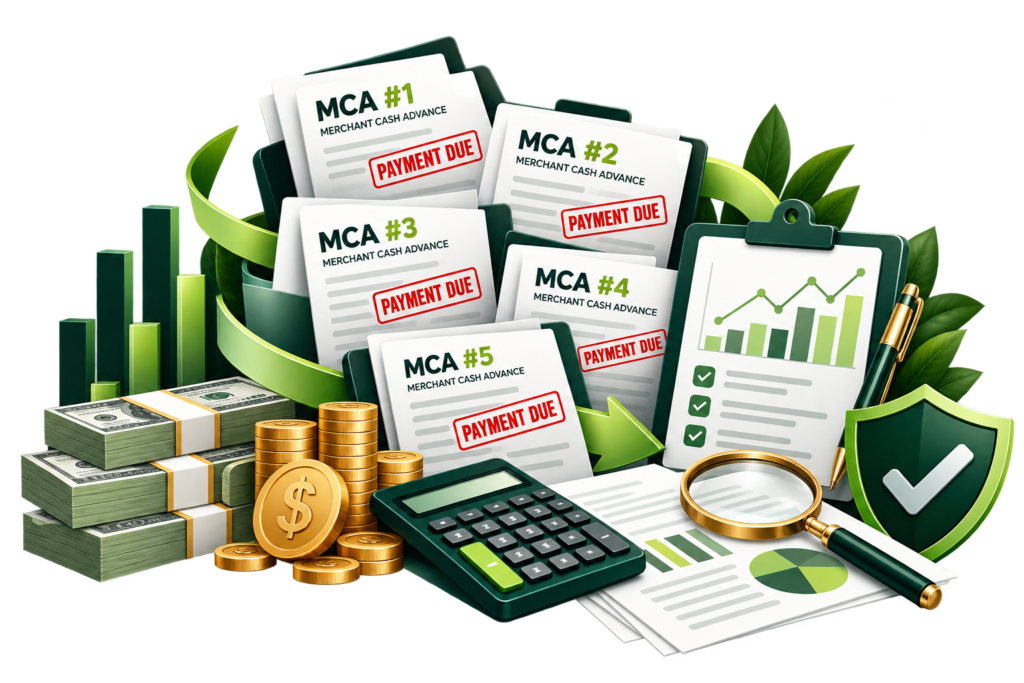
Multiple MCA debt refers to a business carrying two or more merchant cash advances at the same time. Each advance may have its own payment amount, frequency, remaining balance, agreement terms, and funder. As explained in the CFPB’s information on merchant cash advances, these financing arrangements are generally tied to future business revenue.
For example, MCA #1 might collect a daily payment, MCA #2 another daily payment, and MCA #3 a weekly payment. All three ultimately draw from the same operating cash.That can leave less money available for payroll, suppliers, inventory, rent, utilities, and other business expenses.
That is why multiple MCA situations are best understood as a combined cash-flow problem rather than evaluated advance by advance.
The biggest issue with multiple MCAs is often the combined payment burden.
Imagine, as an illustrative example only, a business receiving $20,000 in weekly revenue while paying:
That’s $4,500 of weekly MCA payments before considering payroll, suppliers, rent, inventory, taxes, utilities, and other operating costs. These figures are illustrative, not typical results.
The exact numbers will vary by business, but the principle is straightforward:
Several payment obligations can consume a significant portion of the cash the business needs to operate.
This is why reviewing the entire MCA picture is usually more useful than looking at one payment in isolation.
Having more than one MCA does not automatically mean the business is in trouble.
The more important question is whether the combined obligations are still compatible with the business’s cash flow.
Several daily or weekly withdrawals are taking a growing share of available business cash.
Payroll, suppliers, inventory, rent, or other essential expenses are becoming harder to cover.
Sales have slowed, become seasonal, or are arriving later than expected.
The business is considering new funding mainly to cover existing MCA payments.
Multiple funders are collecting during the same period, leaving less cash between revenue deposits.
The business is missing, returning, or struggling to maintain required withdrawals.
Before considering a solution, build a clear picture of every active obligation.
Identify who currently holds each MCA agreement.
Record the amount originally provided, where known.
Estimate what remains outstanding.
Record the amount being withdrawn.
Identify whether payments occur daily, weekly, or under another schedule.
Note important provisions such as reconciliation rights, payment requirements, default provisions, or other relevant terms.
Estimate how much of your available business cash goes toward MCA payments.
Identify whether each obligation is current, behind, disputed, or otherwise difficult to maintain.
A simple table can make the situation much easier to understand:
| MCA | Payment | Frequency | Approx. Balance | Status |
|---|---|---|---|---|
| MCA #1 | $____ | Daily | $____ | Current |
| MCA #2 | $____ | Daily | $____ | Current |
| MCA #3 | $____ | Weekly | $____ | Review needed |
You don’t need perfect numbers to begin. Estimates can provide a starting point for understanding the overall picture.
There is no single solution that applies to every business with multiple MCAs.
Depending on the agreements, financial position, payment history, and business circumstances, several areas may be worth reviewing.
Start by looking at the combined payment burden and how it fits against actual business revenue and operating expenses.
This helps identify whether the immediate issue is payment frequency, total payment volume, revenue timing, or a broader cash-flow problem.
Some MCA agreements may contain reconciliation provisions that allow payment calculations to be reviewed against actual business receipts.
Whether reconciliation is available and how it works depends on the specific agreement and circumstances.
A reconciliation review is not automatically a debt reduction. It may instead address whether the payment amount is consistent with the applicable contractual terms.
Restructuring may involve exploring revised payment arrangements with a funder.
Depending on the circumstances, this could involve changes to payment amount, frequency, or duration.
However, a lower periodic payment does not necessarily mean a lower total repayment cost.
The complete proposed terms should be reviewed before agreeing to a change.
Settlement involves reaching an agreement with a funder to resolve an outstanding obligation under specified terms.
A settlement may involve a lump-sum payment or an agreed payment schedule.
Whether a funder will accept a settlement, and on what terms, depends on the individual circumstances.
There is no standard settlement percentage that applies to every MCA.
In some situations, a business may explore refinancing, consolidation, or another financing structure.
But new financing is not automatically a solution.
A new obligation can add cost and another payment if it does not genuinely improve the underlying cash-flow problem.
Some reverse consolidation offers can reduce the visible payment burden while adding another obligation and increasing total cost.
So the relevant comparison is not simply:
“Is the new payment lower?”
It is:
“What happens to the total cost, repayment period, cash flow, and overall obligations?”
These terms are related but should not be treated as identical.
Simply means that a business has more than one active merchant cash advance.
Generally refers to taking an additional advance while an earlier advance remains outstanding.
That means a business can have multiple MCAs without every discussion needing to focus on how the advances were obtained.
Our MCA Stacking page explains that concept in greater depth.
When several MCA payments are creating cash-flow pressure, another advance can appear to provide immediate breathing room.
But it also creates another obligation.
The business should consider:
Using new MCA funding to cover existing MCA obligations can add another payment stream rather than resolve the underlying problem.
Before adding another MCA, understand whether the new obligation actually improves the overall financial position or simply adds another payment to the same revenue stream.
A multiple-MCA review can start with basic information.
How many advances are currently outstanding?
What are the total daily or weekly withdrawals?
Approximately how much remains on each obligation?
When does each funder collect?
What does the business typically generate, and how consistent is that revenue?
What cash is needed for payroll, suppliers, inventory, rent, and other essential costs?
Are all payments current, or have there been missed or returned payments?
Is the primary issue payment size, multiple withdrawals, declining revenue, another advance, or possible default?
A case review does not guarantee:
Any potential arrangement depends on the agreements, business circumstances, financial position, and willingness of the relevant funder or creditor to agree to new terms.
Provide basic information about your business and the advances you’re currently managing.
The goal is to understand the number of obligations, payment pressure, and general cash-flow situation.
Depending on the circumstances, the review may identify areas such as payment review, reconciliation, restructuring, negotiation or settlement for a resolution team to discuss.
Where appropriate, MCA Resolution Advisory may connect the business owner with an independent debt resolution team.
MCA Resolution Advisory is not a law firm or debt settlement company. We assess your case and the right resolution team takes it forward. We connect merchants with resolution teams, may be compensated by those firms, and never charge merchants a fee.
Straight answers to the questions business owners ask us most. Still unsure? Talk to our team.
Multiple MCA debt means a business has two or more merchant cash advances outstanding at the same time, each potentially carrying its own payment schedule and contractual terms.
Not exactly. Multiple MCA debt describes the number of active advances. MCA stacking generally refers to taking additional advances while earlier advances remain outstanding.
Potentially, depending on the funders, agreements, business circumstances, and resolution approach. A review of all active obligations can help determine whether a coordinated approach may be appropriate.
Payment changes may sometimes be explored through reconciliation, restructuring, negotiation, or another arrangement, but no specific reduction is guaranteed.
A business may explore coordinated settlement of multiple obligations, but each funder may have different requirements and may not agree to the same terms.
Before adding another advance, compare the new obligation with your existing payment burden, total cost, repayment period, and available operating cash. Additional funding may add another payment obligation rather than solve the underlying issue.
The number alone does not determine what options are available. The more useful starting point is to map each advance, payment amount, frequency, balance, and effect on business cash flow.
No. A business can review its multiple MCA situation while payments are still current. However, the available options can depend on the current payment status and contract terms.
Not necessarily. Reconciliation generally concerns whether payments align with the applicable agreement and actual business receipts. It should not automatically be described as debt forgiveness or balance reduction.
No. MCA Resolution Advisory assesses your case and makes sure the right resolution team assists you. Where appropriate, it may connect business owners with a debt resolution team for further review.
You don’t need to know exactly which solution applies before starting. Tell us about your active advances, payment pressure and business cash flow, and we’ll review the situation.