01
Confirm Completed Obligations
Make sure you understand which MCA obligations have actually been completed and what documentation confirms the resolution.
Paid off or resolved your MCA but unsure what comes next? Post-MCA recovery focuses on stabilizing cash flow, reviewing remaining business debt, and preparing for future financing decisions. At MCA Resolution, we assess your situation and connect you with the right team when appropriate. Start with a free, no-obligation assessment.
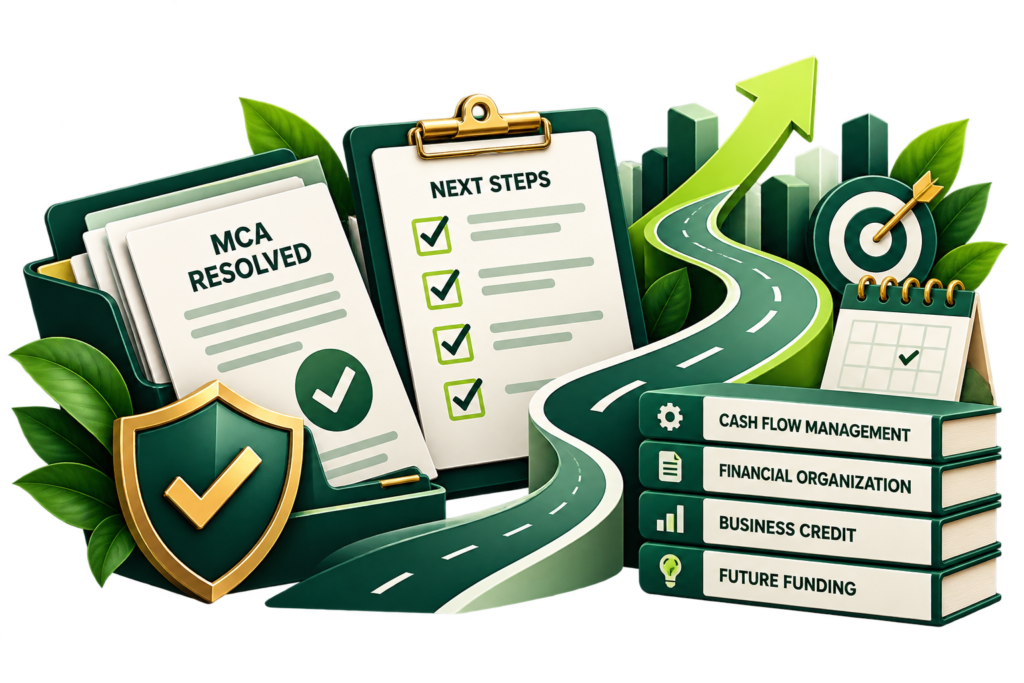
Whether you recently completed an MCA, reached a settlement, or are moving away from frequent short-term financing, the next goal is to build a more stable financial foundation.
Post-MCA recovery is the process of reviewing and strengthening a business’s financial position after an MCA obligation has been repaid, resolved, or otherwise addressed.
The focus shifts from dealing with the immediate MCA obligation to managing the business more sustainably.
That can include:
A completed MCA does not automatically mean that a business is financially ready for its next funding decision.
Once an MCA obligation has been completed or resolved, business owners may need to shift their attention from immediate payment pressure toward longer-term financial organization.
Make sure you understand which MCA obligations have actually been completed and what documentation confirms the resolution.
Other MCAs, loans, credit cards, leases, or business obligations may still affect cash flow.
With the previous MCA payment no longer being made, or potentially changed, the business can evaluate its current cash position more accurately.
Updated financial information can make future business decisions easier to evaluate.
New capital should be considered based on the business’s actual needs and ability to support repayment.
The goal is not simply to replace one source of financing with another.
Start with a clear picture of the business’s current financial position.
Review:
You don’t need perfect numbers to begin an initial review, but accurate information becomes increasingly important as financial decisions become more significant.
Once an MCA obligation is no longer consuming the same level of cash flow, pay attention to where that cash is going.
Consider:
Regular cash-flow reviews can help identify whether the business is actually becoming more stable or simply moving from one payment problem to another.
Future lenders, funding providers, accountants, and financial advisors may need a clearer picture of the business.
Keep important information organized, including:
The goal is better financial visibility, not simply having more documents.
After experiencing MCA payment pressure, it can be useful to reconsider how the business approaches future capital.
Before taking new financing, consider:
This helps shift financing decisions from short-term urgency toward longer-term planning.
The longer-term goal is to create a business that can evaluate financing from a stronger position.
That can involve:
Post-MCA recovery is therefore not simply about what happened with the previous MCA. It is about what the business does next.
One of the most important parts of recovery is understanding what happens to cash flow after an MCA obligation is completed.
For example:
Business revenue was split between the MCA payment, other debt and operating expenses.
Business revenue now covers remaining obligations and operating expenses, leaving more available business cash.
The second structure may provide more flexibility, but the result depends on the business’s actual revenue, expenses, and remaining obligations.
More available cash should not automatically be treated as available borrowing capacity.
An MCA may be only one part of the business’s financial picture.
After an MCA is resolved, review whether the business still has:
Another advance may continue creating daily or weekly payment pressure.
Term loans or other financing may remain outstanding.
Revolving balances can continue affecting cash flow and credit utilization.
Leases or equipment obligations may still require regular payments.
Vendor balances or other business obligations may need attention.
This broader review matters because resolving one obligation does not automatically resolve the entire debt structure.
Post-MCA recovery should also focus on the information a business can use to evaluate its own financial health.
Know what enters and leaves the business each month.
Keep financial records current and organized.
Understand outstanding balances, payment schedules, and obligations.
Know which expenses are essential and which may be reduced.
Maintain financial information that can help when evaluating future financing.
The goal is financial readiness, not a promise of approval.
After an MCA, some business owners may eventually consider additional financing.
That decision should be based on the business’s current financial position, not simply on the fact that an MCA has ended.
Before considering new funding, ask:
Moving toward a more sustainable capital structure and building reserves is usually healthier than immediately replacing one MCA with another.
One of the biggest goals after MCA recovery is avoiding a situation where new short-term financing becomes necessary simply to cover existing obligations.
Track actual operating cash rather than relying only on revenue.
Seasonal businesses should consider slower periods before taking on new repayment obligations.
Don’t evaluate financing based only on the amount deposited into the business account.
Taking multiple advances can create overlapping payment obligations and additional pressure.
Know how the capital is expected to support the business before accepting it.
Depending on eligibility and circumstances, other forms of financing may have different structures and repayment requirements.
Stacking and repeated short-term borrowing can compound cash-flow pressure. Learn more about MCA stacking and cash flow support.
A post-MCA review does not guarantee:
Financial recovery depends on the business’s circumstances and actions over time.
If your business needs legal advice about a UCC filing, contract, judgment, lawsuit, personal guarantee or other legal issue, consult a qualified attorney.
Provide basic information about your business and the MCA obligation that has been repaid or resolved.
Our team reviews the information you provide, including what you know about completed and remaining obligations.
Where appropriate, we may connect you with a resolution team that can explain its services and available support.
You can review the information, ask questions, and decide how you want to proceed.
Straight answers to the questions business owners ask us most. Still unsure? Talk to our team.
Post-MCA recovery focuses on rebuilding financial organization, monitoring cash flow, reviewing remaining obligations, and preparing for future financial decisions after an MCA is repaid or resolved.
Confirm the obligation has been completed, review remaining debts, monitor cash flow, organize financial records, and evaluate future financing carefully.
Potentially, depending on the business, lender, financial information, and other eligibility factors. Paying off an MCA does not guarantee approval for future financing.
Not automatically. The effect depends on how the MCA was reported, the business’s broader credit profile, and other factors.
There is no universal answer. Before taking another MCA, evaluate why the capital is needed, the repayment requirements, the business’s cash flow, and available alternatives.
There is no standard recovery timeline. Financial stability depends on revenue, expenses, remaining obligations, cash management, and other business circumstances.
It can help a business become more financially organized and prepared to evaluate future financing, but it cannot guarantee funding approval.
Other obligations should be included in the financial review. Resolving one MCA does not automatically resolve other business debts.
No. The assessment allows estimates and “Not sure” responses where appropriate. More precise information can be clarified during follow-up.
MCA Resolution Advisory is not a law firm or debt settlement company. We assess your case and the right resolution team takes it forward. Where appropriate, it connects business owners with resolution teams. Legal questions should be addressed with a qualified attorney.
Start building a clearer picture of your business’s next financial chapter. Tell us about your business and your current situation, and our team will review your inquiry.