
MCA Default: What Happens If You Stop Paying?
On this page 12 sections
- What Happens If You Default on an MCA?
- The short answer
- What counts as a default on an MCA?
- What can an MCA funder do after a default?
- Does a personal guarantee put your own assets at risk?
- Will a default hurt your credit?
- What a default can look like, step by step
- Mistakes to avoid when you are behind on an MCA
- What to do first if you are behind
- Options if you are in or near default
- Frequently asked questions
- Get a clearer picture before your next step
What Happens If You Default on an MCA?
Wondering what happens if you default on an MCA? A missed payment can lead to collection calls, additional fees, UCC enforcement issues, or even a lawsuit. For a business already struggling with cash flow, these risks can feel overwhelming. An MCA default does not always trigger immediate legal action. The consequences depend on your agreement, the reason payments stopped, and applicable state law.
This article explains what can happen after a merchant cash advance default, the risks to your business, and the steps you can take to understand your options.
Get Your Free MCA Debt Assessment
The short answer
If you default on a merchant cash advance (MCA), the funder may demand the remaining amount, attempt further withdrawals, pursue collection, enforce valid security rights, or file a lawsuit. A personal guarantee may also create liability for the business owner.
However, an MCA default does not automatically mean your bank account will be frozen or your personal assets seized. The funder’s rights depend on the contract and applicable law. Payment adjustments, negotiation, or settlement may be possible.
What counts as a default on an MCA?
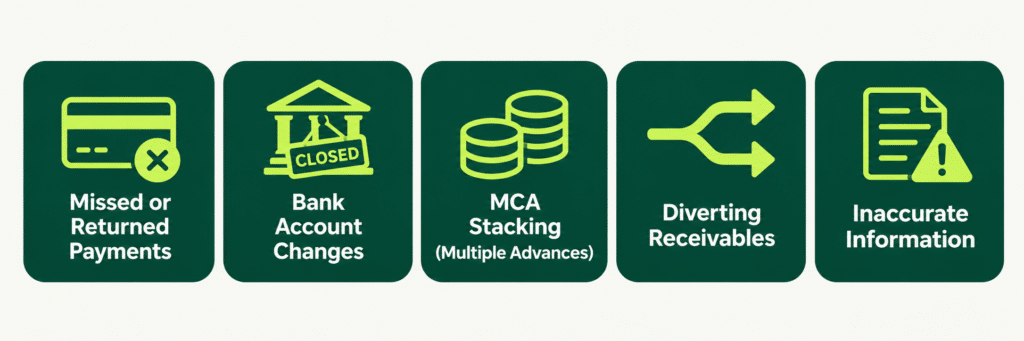
An MCA default occurs when a business violates a condition defined in its merchant cash advance agreement. MCAs typically provide upfront funding in exchange for a portion of future business receivables. Unlike traditional loans, their legal treatment depends on how the agreement is structured and operates.
Common default triggers include:
- Missed or returned payments: Scheduled withdrawals fail, potentially violating the agreement.
- Bank account changes: Closing an account or blocking authorized withdrawals may breach contractual terms.
- Additional financing: Taking another advance may violate restrictions on MCA stacking.
- Diverting receivables: Redirecting business revenue contrary to contractual requirements may trigger default.
- Incorrect information: Providing materially inaccurate financial information may violate the agreement.
A single failed payment does not necessarily establish a legally enforceable default. Review the contract’s events-of-default provisions, notice requirements, and any available cure period. A business debt schedule can help organize your obligations and payment dates.
What can an MCA funder do after a default?
The consequences of an MCA default vary. Some funders first request payment information, while others pursue contractual remedies more quickly.
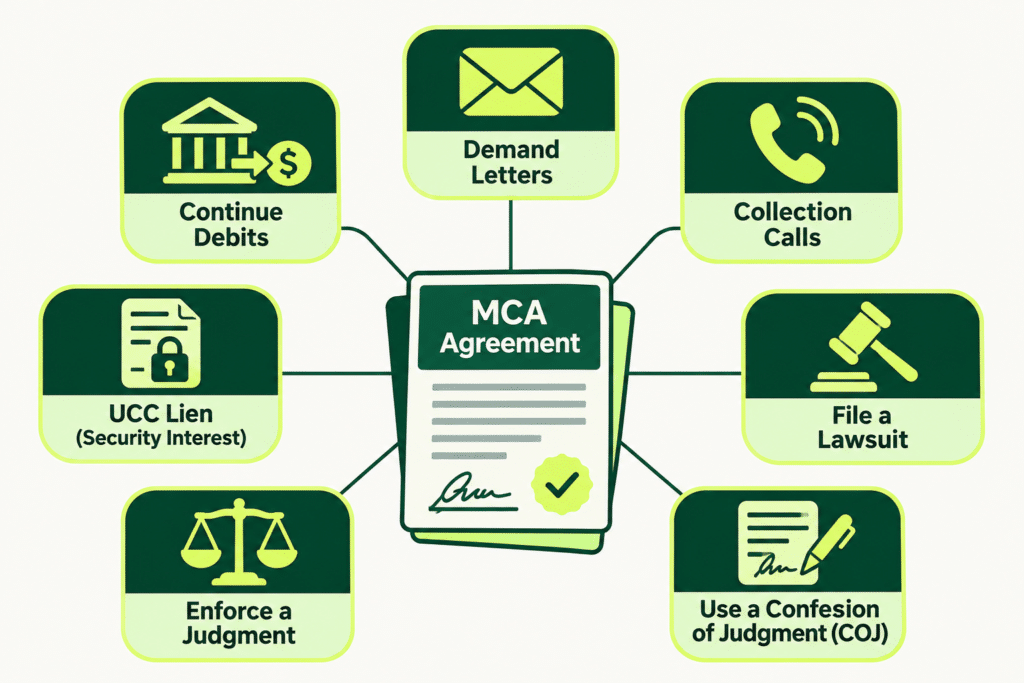
Demand the full balance
Some MCA agreements contain acceleration provisions allowing the funder to demand the remaining purchased amount after a qualifying default. This can create immediate financial pressure. However, whether the demand is enforceable depends on the agreement and applicable law.
Keep debiting your account
A funder may continue attempting ACH withdrawals under an applicable payment authorization. Failed withdrawals may also result in contractual fees. However, authorization terms and applicable payment rules matter; an MCA agreement does not permit unlimited withdrawals.
Daily collections can be particularly difficult when revenue falls. Understanding MCA daily payments versus weekly payments can help explain the pressure on working capital.
Send demand letters and make collection calls
The funder or its representatives may contact your business requesting payment, financial information, or a response to an alleged default. Keep copies of all communications and request written explanations of disputed amounts.
Federal consumer debt collection protections generally do not apply to ordinary business debts, although other federal and state laws may still apply.
File or enforce a UCC lien
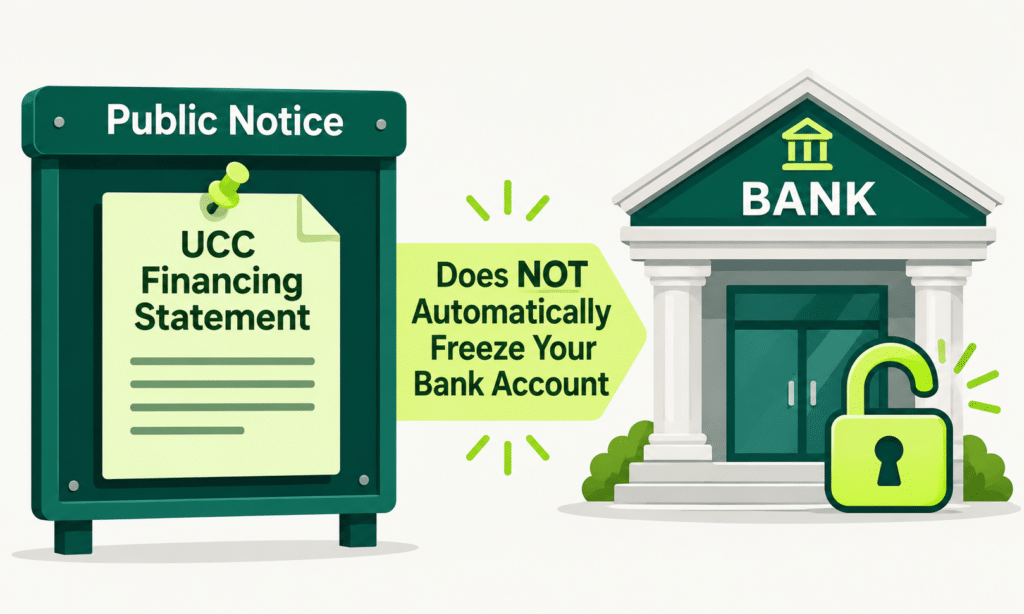
Many MCA agreements involve security interests in business receivables or other collateral. A UCC financing statement generally provides public notice of a claimed security interest. It does not, by itself, automatically freeze a business bank account.
Depending on the security agreement and applicable law, a secured funder may have rights involving certain receivables, payment processors, or collateral.
The legal framework is explained in Article 9 of the Uniform Commercial Code.
Sue the business and the guarantor
An MCA funder may file a lawsuit alleging breach of contract or another legally recognized claim. If you receive a summons, review the response deadline immediately. Failing to respond may allow the funder to seek a default judgment under applicable court procedures. A personal guarantor may also face claims, depending on the guarantee’s wording.
Enforce a judgment
If a funder obtains an enforceable judgment, additional collection measures may become available. These can include bank levies, garnishment, or other court-authorized remedies, subject to state procedures and exemptions. A judgment does not mean every business or personal asset can automatically be seized.
Use a confession of judgment (COJ)
Some MCA agreements contain a confession of judgment provision. A COJ may permit judgment through a special procedure without an ordinary contested lawsuit, where legally authorized. States regulate these provisions differently. New York, for example, restricts certain confession-of-judgment filings. An attorney should determine whether a provision in your agreement is valid and enforceable.
Does a personal guarantee put your own assets at risk?
A personal guarantee can expose a business owner to liability, but an MCA default does not automatically make every owner personally responsible. Some guarantees apply only to specified misconduct, such as intentionally diverting receivables. Others contain broader payment obligations.
The distinction matters because a business experiencing declining sales is not necessarily committing the same contractual breach as an owner deliberately redirecting funds. Before agreeing to personal repayment demands, have a qualified attorney examine the guarantee and alleged default.
Will a default hurt your credit?
An MCA default may make future financing more difficult, but it does not automatically lower your personal credit score. Some MCA providers do not routinely report payments to traditional credit bureaus. However, lenders may discover lawsuits, judgments, UCC filings, or other financial problems during underwriting.
The impact depends on reporting practices, personal obligations, and the lender’s evaluation process. A public UCC filing or civil judgment is not the same as a negative entry on a personal credit report.
What a default can look like, step by step
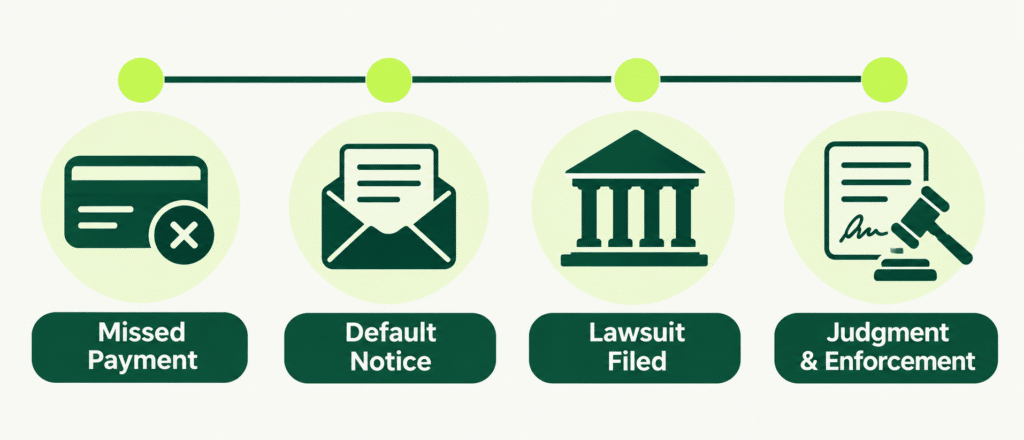
There is no universal MCA default timeline. The following example illustrates possible stages, not a guaranteed sequence.
| Stage | What may happen | What you can do |
|---|---|---|
| 1. Missed payment | Failed withdrawal, contact from funder, possible fees | Review your agreement and payment records |
| 2. Default notice | Demand for payment or contractual enforcement notice | Request written details and legal review |
| 3. Lawsuit | Funder files a claim against the business or guarantor | Record the deadline and contact an attorney |
| 4. Judgment | Court-authorized collection may become possible | Review legal protections and possible resolution options |
Some disputes resolve before litigation. Others may proceed directly to formal action, depending on the circumstances.
A real example of why MCA agreements matter
In January 2025, the New York Attorney General announced a settlement involving Yellowstone Capital and related companies that canceled approximately $534 million in outstanding merchant debts. The state alleged that the companies used illegal high-interest loans disguised as merchant cash advances, including misleading reconciliation practices.
The settlement applied to specific companies and agreements. It did not invalidate merchant cash advances generally. The case shows why contract terms, actual collection practices, and applicable law deserve careful examination.
Source: New York Attorney General — Yellowstone Settlement.
Mistakes to avoid when you are behind on an MCA
When business revenue falls, quick decisions can sometimes make an MCA default more difficult to resolve.
Avoid these common mistakes:
- Ignoring legal notices: Missing a court deadline can create serious consequences even if you dispute the claim.
- Closing accounts without advice: Blocking withdrawals may violate your agreement or complicate negotiations.
- Taking another expensive advance: Additional financing may increase payment pressure and create new contractual conflicts.
- Signing without reviewing costs: A revised agreement may introduce fees, guarantees, or additional obligations.
- Sharing sensitive information: Do not provide passwords, bank login credentials, or unnecessary personal information during an initial inquiry.
Keep records of communications, payment history, and proposed changes. Written documentation can be valuable if the dispute escalates.
What to do first if you are behind
If an MCA default is approaching or has already occurred, focus on understanding your financial and legal position.
- Check for legal documents. If you received a summons, judgment notice, or account-restraint notice, contact a qualified attorney promptly.
- Gather your agreements. Collect MCA contracts, amendments, payment records, and funder correspondence. Review the default and reconciliation provisions.
- List your obligations. Record every MCA, business loan, payment amount, and withdrawal date using a business debt schedule.
- Review cash flow. Calculate the amount available after payroll, rent, taxes, and essential operating expenses. Identify what your business can realistically sustain.
- Request an initial assessment. A free MCA debt assessment can help you explain your circumstances and explore whether referral to a resolution team is appropriate.
Avoid making assumptions about what a funder can legally collect without reviewing your specific agreement.
Options if you are in or near default
An MCA default does not necessarily mean every resolution option has disappeared.
Depending on your circumstances, a qualified professional may discuss several approaches.
| Potential option | What it involves |
|---|---|
| Payment reconciliation | Reviewing collections against actual revenue where the contract permits |
| MCA payment reduction | Exploring changes to payment amounts or schedules |
| MCA debt negotiation | Discussing possible revised terms with the funder |
| MCA debt settlement | Exploring an agreed resolution of an outstanding obligation |
| Business debt restructuring | Reviewing multiple obligations and possible changes to repayment arrangements |
None of these options guarantees acceptance, debt reduction, or protection from collection activity. A lower payment may extend the repayment period or increase total costs, depending on the agreement.
For additional information about default-related assistance, visit MCA Default Help.
Frequently asked questions
Can an MCA company freeze my bank account?
Not automatically. Account restrictions may arise through valid legal enforcement procedures or applicable security rights, depending on state law.
Can an MCA company sue me personally?
Possibly, especially if you signed an enforceable personal guarantee. Liability depends on its terms and the alleged breach.
How long do I have to respond to an MCA lawsuit?
Deadlines vary by court and state. Check your summons immediately and seek legal advice before the deadline.
Will an MCA default affect my credit score?
Not necessarily. Reporting practices vary, although collections and public legal records may affect future financing decisions.
Can I go to jail for not paying an MCA?
Generally, no. Ordinary business debt default is a civil matter, although separate misconduct or violating court orders can create legal consequences.
Should I stop paying my MCA to avoid more fees?
Do not change payments without understanding the consequences. Review your agreement and obtain qualified advice first.
Can an MCA default be settled?
Sometimes. A funder may consider negotiated terms, but acceptance and outcomes are never guaranteed.
What is a confession of judgment?
A COJ is a legal mechanism permitting judgment through a special procedure where state law allows it. Enforceability varies.
Get a clearer picture before your next step
An MCA default can leave you worried about your bank account, business operations, and financial future. Understanding your agreement and available options is an important first step.
MCA Resolution provides a free initial assessment for business owners experiencing merchant cash advance or business debt difficulties.
Our team reviews the information you provide and, where appropriate, connects you with a debt resolution team for further discussion of potential services, fees, and terms. You decide whether to proceed. The initial assessment carries no obligation and does not require your Social Security number or bank login.
Get My Free MCA Debt Assessment →
This article is general information, not legal, tax or financial advice. Every business and agreement is different.